

3 ta eng keng tarqalgan dinamik drayverlari: shox, konus va gumbaz
All speakers are essentially transducers, which means that they convert one form of energy-in this case electricity-into another form-in this case, we take the form of sound Experience mechanical vibration. Since the role of the transducer is to push or "drive" the sound forward, the term "driver" is usually used to refer to the transducing element in the speaker. Drivers are sometimes referred to simply as speakers. This term also refers to the sum of all the components that produce sound from the housing to the internal sound damping material and other components (such as crossovers). In this article, "speakers" and "drivers" refer to the speaker components responsible for dispersing sound.
Karnay
Nomidan ko'rinib turibdiki, shoxli karnay xuddi shox kabi ochiq huni shakliga ega. Ko'p odamlar ushbu dizaynni eski grammofonlar (shuningdek, fonograflar deb ataladi) rasmlaridan bilishadi. Ilk dizaynlarda tebranish diafragma tomonidan ishlab chiqarilgan tovushni kuchaytirish uchun shoxlardan foydalanilgan: shox ikkita funktsiyaga ega: diafragma tomonidan hosil bo'lgan tebranishni havoga uzatish va uni balandroq qilish.

The horn loudspeaker is a very effective design because, compared to a cone-shaped diaphragm, the diaphragm does not have to oscillate violently in order to produce a loud sound. Due to their high efficiency, speakers are still used in PA speakers to send out notification and warning signals. Another advantage of horn speakers is their directivity. The sound can be directed at the listener instead of dispersing the sound throughout the room. This creates a much smaller "sweet spot" for the listener, but eliminates most of the problems people encounter in room acoustics because there are fewer reflected sounds. However, this small optimal listening area may be a bit impractical and is usually not conducive to appreciation of the high range, because the high range tends to beam rather than disperse anyway. Another practical difficulty with horn speakers is the extremely low end. In order for the horn speaker to reproduce convincing bass, it must have a huge size.
Uyda yuqori aniqlikdagi audio-cheklovlarga qaramay, bugungi kunda hali ham koʻplab yuqori sifatli karnaylar mavjud. Ko'pchilik ularning ajoyib dinamikasi va tez o'tkinchi javobini qadrlashadi, bu musiqa, ayniqsa jazz uchun juda real jonli ovozni ta'minlaydi. Shox ham buzilmasdan baland ovozda chalinishi mumkin. Va nihoyat, shoxli karnaylar suhbatning jozibali qismlaridir.
Dinamik drayveri Ultima 40 Mk2 jozibali mis o'rta diapazonli haydovchi
Konusli karnay
Cone is a form we know in school geometry class, used in the most popular form of driver structure: cone loudspeaker. A typical cone driver consists of a tapered membrane with a dust cap in the middle and a component that does not affect the sound. For sound reproduction, the membrane is responsible. The membrane is attached to the voice coil, and the voice coil moves in accordance with the push and pull of the magnetic field generated by the current passing through the coil in the magnetic field. This movement in and out (referred to as offset) makes the cone speaker the most dynamic reason for the driver design discussed here, and is why this type of driver is sometimes referred to as a "dynamic speaker." The longer the driver's stroke, the greater the amount of air it can push. In order to create low-frequency sound, a lot of air needs to be moved, which can be achieved by using a large woofer or increasing the driver offset. In view of all these changes, cone speakers are not as efficient as horn speakers, but allow for more compact, user-friendly speaker designs and a more powerful and accurate low end.
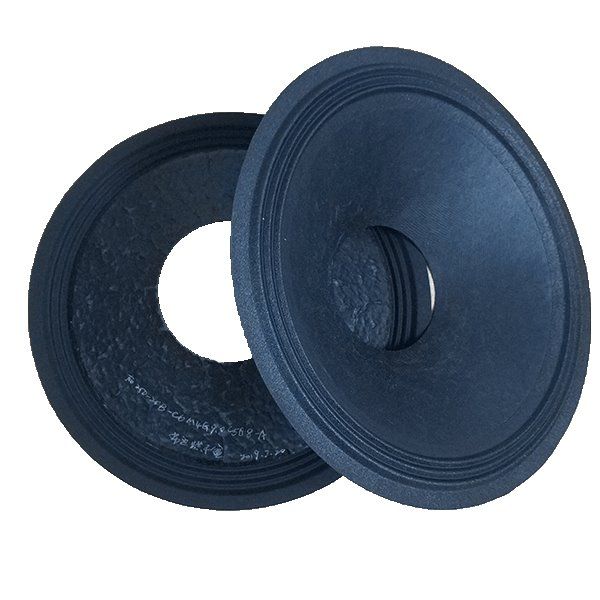
Konusning karnayining diafragmasi (u konusning o'rniga yumaloq bo'lishi mumkin) har xil materiallardan tayyorlanishi mumkin, ularning barchasi bir xil yuqori qattiqlik va engil vaznli xususiyatlarga ega. Qog'oz, alyuminiy, aramid, polipropilen va polistirol konusning drayvlarini qurishda keng tarqalgan materiallardir. Konusning dinamiklari ko'plab turli stsenariylarda qo'llaniladi, lekin asosan o'rta va bosh drayverlarini yaratish uchun ishlatiladi. Ular ba'zan tweeter dizaynlarida qo'llanilsa-da, gumbaz drayverlari odatda bu erda samaraliroq.
Gumbazli karnay
Shoxlar va konusning karnaylari kabi, bu nom deyarli bu shaklni tasvirlaydi. Gumbazli dinamiklar odatda konkav va konusli dinamiklardan kichikroqdir. Biroq, ushbu dizaynning afzalligi shundaki, u yuqori chegara chastotasining nurlanish tendentsiyasidan qochish uchun yuqori chegara oralig'i uchun kengroq tarqalish burchagini ta'minlaydi.
Dome tvitteri
Unlike horn speakers, dome speakers are a fairly new invention. In the 1960s, the German company Braun successfully used dome speakers for the first time. The original design came from an Italian manufacturer, but Braun engineers had the idea of using different materials. After many trials, BASF's composite materials of tar, rubber, glue and paint were chosen and succeeded. Since then, dome tweeters have been widely used, and the use of structural materials is as diverse as those used in cone membranes: aluminum, ceramics, titanium, beryllium and even silk are often used.
Coda: Ovoz va quvvatga bag'ishlangan dinamik drayveri
Since the invention of the phonograph in 1877, the driver design has changed a lot. Although the use of horn speakers outside of PA systems is quite rare, cone and dome speakers can be found in almost every home. Today's typical speaker systems usually use a combination of cone and dome drivers-cones for midrange and bass, and domes for treble ranges.


